

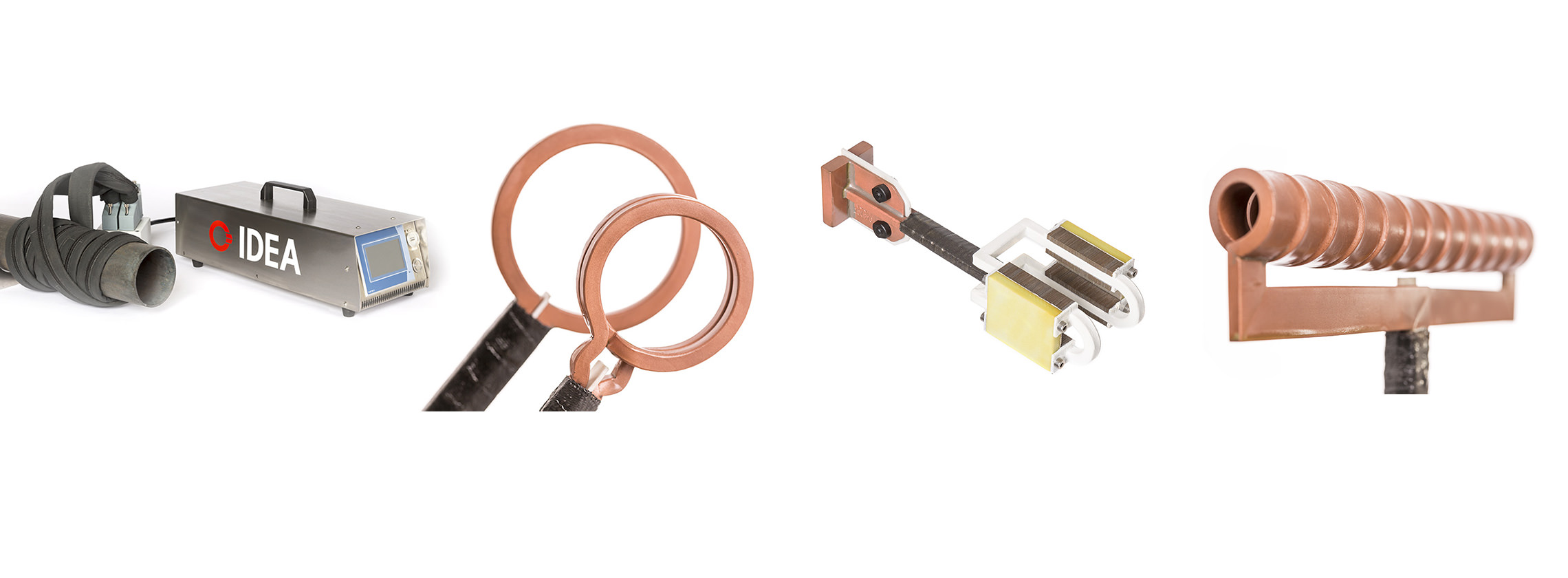
Induction coil geometry plays a critical role in determining how heat is generated and applied to a workpiece. Different coil types are designed to control heating depth, distribution and efficiency based on the application.
At IDEA, coil selection and design are based on the specific requirements of the process, including induction hardening, brazing and joining, straightening and cable heating.
Induction Coil Design and Geometry
The geometry of an induction coil defines the electromagnetic field and how energy is transferred to the part.
Key factors include:
- Shape and size of the workpiece
- Required heating zone
- Depth of heat penetration
- Frequency and power input
- Positioning and coupling distance
Selecting the correct coil type ensures uniform heating, efficient energy transfer and stable process performance.
Solenoid Coils
Solenoid coils are one of the most common induction coil types. They consist of helical windings that surround or partially surround the workpiece.
Typical applications:
- Induction hardening of shafts and cylindrical components
- Heating of rods, tubes and bars
Advantages:
- Uniform heating along the length of the part
- Efficient coupling for cylindrical geometries
- Suitable for automated processes
Pancake Coils
Pancake coils are flat, spiral-shaped coils used for surface heating applications.
Typical applications:
- Brazing and joining of flat components
- Surface heating and localized treatment
Advantages:
- Concentrated heating near the surface
- Suitable for flat or irregular surfaces
- Good control of heating area
Channel Coils
Channel coils are designed to follow the contour of a specific part or heating path.
Typical applications:
- Straightening and repair processes
- Heating along defined edges or contours
Advantages:
- Precise alignment with complex geometries
- Controlled and localized heat input
- Adaptable to custom applications
Internal Coils
Internal coils are inserted into hollow components to heat from the inside.
Typical applications:
- Heating of tubes and hollow parts
- Internal brazing and joining operations
Advantages:
- Efficient heating from inside the component
- Uniform internal temperature distribution
- Reduced heat loss to surrounding areas
Cable Heating Coils and Systems
Specialized induction coils are used for cable heating applications, often in combination with air-cooled cable systems.
Typical applications:
- Cable heating with air-cooled cables
- Continuous heating processes
Advantages:
- Flexible system integration
- Efficient energy transfer in continuous operation
- Reduced need for water-cooled connections in certain setups
Custom Induction Coil Designs
Standard coil types are often adapted or combined to meet specific process requirements.
IDEA develops custom coil designs based on:
- Part geometry and production setup
- Required heating pattern and cycle time
- Integration into automated systems
Custom solutions are especially important in applications such as induction hardening, brazing and straightening, where precision and repeatability are critical.
Application-Specific Induction Coil Configurations
In addition to general coil geometries, induction coils are often described based on how they are applied to the workpiece.
Common configurations include:
- Fork coils – used for localized heating and scanning applications
- Hairpin coils – suited for heating defined areas on flat or cylindrical parts
- Face heating coils – designed for heating surfaces or end faces
- Outside heating coils – used for external heating of components
- Inside heating coils – used for heating internal diameters and bores
These configurations are typically derived from standard coil geometries and adapted to meet specific application requirements.
Additive Manufacturing and 3D-Printed Induction Coils
Additive manufacturing enables the production of complex induction coil geometries that are not feasible with conventional fabrication methods.
3D-printed coils allow for:
- Complex internal cooling channel designs
- Optimized flow paths for improved thermal performance
- Geometries closely matched to part contours
- Reduced assembly requirements
Typical applications:
- Induction hardening of complex components
- Brazing and joining in confined or irregular geometries
- Specialized heating applications with tight spatial constraints
Advantages:
- Improved cooling efficiency through optimized channel design
- Greater design flexibility for complex parts
- Potential for reduced thermal stress and improved coil life
Additive manufacturing is particularly valuable in applications where conventional coil designs are limited by geometry or cooling constraints.
Selecting the Right Induction Coil
Choosing the correct coil type is essential for achieving the desired heating result.
Factors to consider:
- Application type and process requirements
- Material and geometry of the workpiece
- Required heating depth and temperature
- Production environment and automation level
Proper coil selection improves efficiency, reduces energy consumption and ensures consistent process results.
Work with an Induction Coil Design Specialist
Whether you need support selecting a coil type or developing a custom design, IDEA provides engineering support tailored to your application.
👉 Request a Consultation
👉 Discuss Your Application
Schedule a Short Process Review
Call us: +49 (0) 7445 85445-0 or send the form below: